Skip to content

Samples / beatmakers / DJ flips

Hear the craft.

Samples, producers and DJ flips, broken down slide by slide so you can hear how the music gets made.

Now playing

Stories

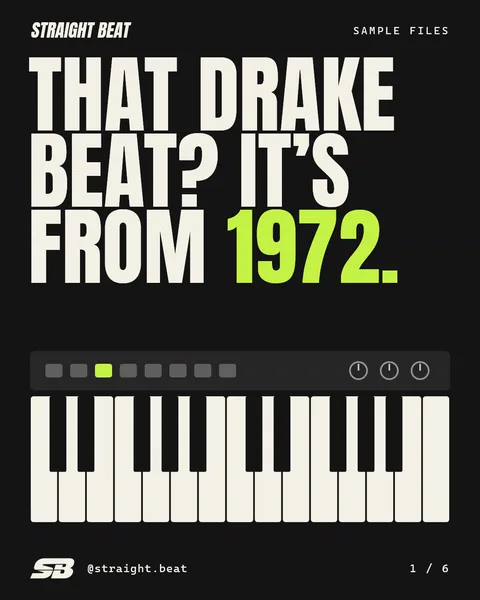
Typographic cover on black: That Drake beat? It’s from 1972. Below, an organ keyboard with a row of rhythm buttons, one lit acid green.
The original: Timmy Thomas, Why Can’t We Live Together, from 1972, written, sung, played and produced by Thomas. A vinyl record graphic sits in the corner.
One man. No band. Icons for voice, organ and drum machine join in a bracket under the name Timmy Thomas: an anti-war plea from the Vietnam era, recorded alone.
He mostly tried to stay out of the way. Flow diagram: car radio (Why Can’t We Live Together), sped up, plus light drum programming, Hotline Bling (2015). Credited to The FADER, 2016.
Quote on acid green: “Thank you. You changed me and my family’s life.” Timmy Thomas to Nineteen85 on the phone, as the producer told CBC’s Q in 2023.
Listening order: Timmy Thomas’s Why Can’t We Live Together, then Drake’s Hotline Bling. At the end, only the 1972 beat remains.

Sample Files6 slides

The one-man 1972 record under Hotline Bling

Drake’s Hotline Bling samples Timmy Thomas’s Why Can’t We Live Together, a 1972 record Thomas made alone with his voice, an organ and a drum machine. Producer Nineteen85 sped it up and added light drum programming.

1972
Timmy Thomas’s Why Can’t We Live Together
No. 2
Hotline Bling’s Billboard Hot 100 peak
2
Grammys won by Hotline Bling
Research and credits

Typographic artwork by Straight Beat.

Typographic cover: That Jay-Z hook? That’s Annie. The answer sits inside a black theatre marquee lined with bulbs.
The original: It’s the Hard-Knock Life from Annie, sung by Andrea McArdle and the orphans on the 1977 original Broadway cast recording. Music by Charles Strouse, lyrics by Martin Charnin. A vinyl record graphic sits in the corner.
Timeline titled Twenty years later. 1977: Annie opens on Broadway and its cast album arrives. 1997: a TV ad for the Broadway revival gives the 45 King an idea. 1998: Jay-Z releases Hard Knock Life (Ghetto Anthem).
A large 25¢ on acid green: what the 45 King paid for the Annie record at a Salvation Army store.
He came for the horns. He kept the kids. Three stacked lanes show the 45 King’s method: find stuff (the orphans’ chorus), put drums under it, come up with a bass line. Credited to Grantland’s 2014 oral history.
Listening order: the Original Broadway Cast of Annie’s It’s the Hard-Knock Life, then Jay-Z’s Hard Knock Life (Ghetto Anthem). Listen for the kids.

Sample Files6 slides

The Annie chorus behind Hard Knock Life

Jay-Z’s Hard Knock Life (Ghetto Anthem) samples It’s the Hard-Knock Life from the 1977 original Broadway cast recording of Annie. Producer the 45 King found the song after seeing a TV ad for the show’s 1997 Broadway revival.

1977
Annie opens on Broadway; its cast album follows
25¢
What the 45 King paid for the Annie record
No. 15
Hard Knock Life’s Billboard Hot 100 peak
Research and credits

Typographic artwork by Straight Beat.

Typographic cover on acid green: Money Trees? That’s Beach House. Backwards. A vinyl record with an arrow turning counterclockwise.
The original: Beach House, Silver Soul, from Teen Dream (2010), the Baltimore duo’s third album. DJ Dahi recalls getting it from a friend who kept sending him alternative records.
Loop, chop, reverse: DJ Dahi’s three ways to work a sample, each with an icon. Reverse is bracketed in acid green and tagged Money Trees. Credited to NPR’s The Formula.
Schematic diagram titled Same sound. Other direction. A sound as recorded starts with an attack and fades out; reversed, it swells and then cuts off.
Quote on acid green: “I just reversed it” … “and then put it through some turns and a couple effects.” DJ Dahi on making Money Trees, Red Bull Music Academy, 2017.
Listening order: Beach House’s Silver Soul, then Kendrick Lamar’s Money Trees featuring Jay Rock. Listen for Silver Soul running backwards.

Behind the Beat6 slides

Money Trees and the backwards Beach House sample

DJ Dahi built Kendrick Lamar’s Money Trees from Beach House’s Silver Soul, a song on the duo’s 2010 album Teen Dream. He played the sample in reverse, then added effects.

2010
Beach House release Silver Soul on Teen Dream
2012
Money Trees appears on good kid, m.A.A.d city
3
DJ Dahi’s sampling moves: loop, chop, reverse
Research and credits

Typographic artwork by Straight Beat.

AI editorial illustration of Kanye West beside the hook: That Kanye hook? That’s Chaka.
AI editorial illustration of Chaka Khan identifying Through the Fire from her 1984 album I Feel for You.
Timeline: Kanye recorded the first version after a 2002 crash with his jaw wired shut, then rerecorded it in 2003.
Diagram showing Chaka’s original chorus becoming the sample in Kanye’s hook.
Faster, higher: a four-semitone pitch rise attributed to Jeremy Tatar’s analysis.
Chaka’s love-song chorus becomes part of Kanye’s recovery story.
Listening order: Chaka Khan’s Through the Fire, then Kanye West’s Through the Wire.

Sample Files7 slides

The Chaka Khan vocal behind Through the Wire

Kanye West samples Chaka Khan’s Through the Fire, from her 1984 album I Feel for You. The sped-up recording gives his hook its high register.

1984
Through the Fire appears on Chaka Khan’s I Feel for You
+4
Semitones higher in Jeremy Tatar’s analysis
2003
Kanye rerecords Through the Wire
Research and credits

AI editorial illustrations of Kanye West and Chaka Khan by Straight Beat.

Sample or interpolation? A split vinyl record and keyboard on acid green.
A sample uses original audio in a new track, illustrated with a selected waveform and vinyl record.
An interpolation performs a musical part again for a new recording, illustrated with piano hands.
Comparison: original audio means sample; played again means interpolation. Research credit to Tracklib.

Behind the Beat4 slides

Sample or interpolation?

A sample uses part of an existing recording. An interpolation recreates a musical part in a new performance. That difference starts with the source of the sound.

Sample
Uses part of an existing recording
Interpolation
Recreates the part in a new performance
Research and credits

Illustrative artwork by Straight Beat.

Producer news & sessions

Studio Notes

  1. BeatStars

    BeatStars Projects keeps sessions, stems and splits in one place

    The new workspace stores stems, DAW sessions, contracts and artwork, and turns proposed splits into timestamped agreements once every collaborator accepts. Storage is included on every plan, from 2GB free to 25GB on Professional.

  2. Splice

    Alina Smith builds a beat from ocean sounds and oddball samples

    Splice’s Beat the Odds challenge gives Smith a budget and a board of sounds. She combines unusual samples, drums, synths and her own vocals into a pop track.

  3. Spotify

    Fresh Finds Forward offers studio time and production tools

    Eligible Fresh Finds artists can opt into 12 months of benefits, including LANDR and Splice access. Free studio time is available to U.S.-based participants.

    Read Straight Bars coverage
  4. Splice

    Madlib and Soul Surplus make the source material

    Madlib’s first Splice sample pack was made with Soul Surplus. The accompanying studio session follows the team as they create four of its loops.

Made something worth replaying?

Tag @straight.beat and use #SBSamples on Instagram.

Find Straight Beat on Instagram